Resources
Resources
Resources
What’s New
Study estimates $1.7B cost to expand subsidized childcare, raise teacher pay
September 14, 2026
|
VPM
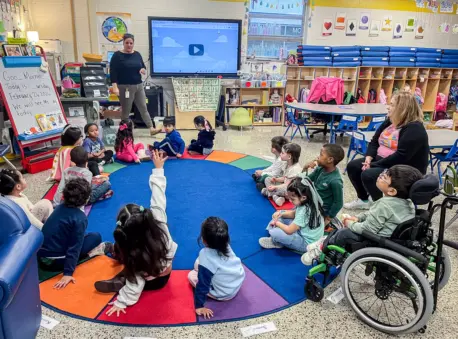
t would cost nearly $1.7 billion to expand access to subsidized childcare in Virginia and pay early childhood educators more, according to a new study. The new research comes as the commonwealth recently took steps to fund — and clear — the waitlist for one popular program. But experts and advocates say that the waitlist is only one indicator of demand for subsidized childcare.
3 in 4 U.S. voters say the cost of childcare is a major problem, survey finds
August 27, 2026
|
VPM
A new survey finds 3 in 4 U.S. voters say the cost of childcare is a major problem — and it’s among reasons affordability is a top issue this election year. For parents who pay for childcare, more than a third say it’s one of their top two expenses, according to a poll commissioned by the First Five Years Fund, which advocates for expanding early learning and care.

Pilot program connects childcare centers with substitute teachers via app
August 3, 2026
|
VPM
In most schools, substitute teachers are commonplace. Finding temporary teachers to fill in at childcare centers is a bit more complicated. But a new pilot program helps daycares in the Richmond region hire qualified substitutes through an app.

VPM’s 90by5 campaign reaches new audiences as expansion continues
August 3, 2026
|
VPM
Have you heard about VPM’s “When, Then - 90by5” early childhood messaging campaign? Since the campaign expanded into Charlottesville earlier this year, the campaign has connected 107,000 parents and caregivers to helpful resources, such as interactive games, activities, posters and other educational content. But what is the 90by5 campaign and why is it important? “The name 90by5 reflects the fact that 90% of a child’s brain develops by age 5,” said Mary Jo Grieve, VPM’s Director of Early Childhood Care and Education. “The "When, Then" message reinforces a simple idea: When parents and caregivers engage with young children through everyday interactions, then those children build the skills they need to succeed in school and in life.”
Proposed $1.68 Billion Child Care Investment Would Generate $1.79 Billion in New Annual Wages and Resources for Virginia Families and Businesses
August 3, 2026
|
Prenatal-to-3 Policy Impact Center
Virginia has been a national leader in child care for years, using federal pandemic funds and state dollars to expand and maintain access to affordable, high-quality care for working families across the state. Virginia’s investments have raised child care quality and have increased access to care for families. However, gaps remain: early childhood educators continue to earn well below a living wage, and child care remains unaffordable for many Virginia families. Virginia’s strategic access to relevant data has made it possible to project the annual cost of increasing educator wages to parity with elementary school teachers and funding access to high-quality child care that aligns with parent demand. Assuming an uptake of 70% of children in eligible working families, this expansion would require a new annual investment of $1.68B per year.
Breastfeeding Support (opens in new window)
At VCU Medical Center, we fully support your decision to breastfeed your baby and will do everything we can to help you succeed. Our breastfeeding consultants are available 7 days a week and will visit you and your baby throughout your stay, offering advice and support.
Just Ask - Parent & Provider Resource Line (opens in new window)
Just Ask is a Parent & Provider Resource Line from VCU's Partnership for People with Disabilities. Just Ask connects families and early childhood professionals with trusted guidance, information, and resources for children 0-7. This free resources is available 24/7. Support is just a call or click away!
The Employee Benefit that Pays for Itself (opens in new window)
Read on for a landmark study on the impact of child care benefits at five US employers, from Moms First and Boston Consulting Group.
Investing in child care: How U.S. businesses can unlock up to $70 billion by providing child care benefits (opens in new window)
The U.S. child care crisis is quietly costing businesses up to $70 billion annually in lost workforce output, with the majority of impact concentrated among foundational workers who power essential industries. Despite the cost, child care benefits remain a major missed opportunity—only ~15% of employers offer them. Based on a national survey of ~1,700 parents, we quantify how child care instability drives absenteeism, non-participation, attrition, and presenteeism—ultimately leading to measurable economic cost. Our analysis shows that targeted employer-led interventions to reduce these disruptions can deliver universally positive returns on investment, ranging from averages of 5% to nearly 300% when feasibility and employee preference are aligned. Solving the child care crisis will take serious and sustained growth in public investment, but businesses can act now to reduce costs and support the working parents who make it all possible. The implication is straightforward: Child care is essential workforce infrastructure, and companies that act now can convert hidden losses into measurable returns.
ECCE Gap Analysis Story Maps: Access to Child Care in Ready Region Central (opens in new window)
In 2026, Reinvestment Fund (RF) partnered with Thrive Birth to Five (TB5) and Virginia Early Childhood Foundation (VECF) to conduct an ECCE gap analysis across Ready Region Central (RRC). The analysis was conducted in close consultation with local stakeholders and designed to support efforts to improve access to high-quality early learning for children and families across the region. This page provides an overview of the analysis and findings, highlighting regional supply, demand, and availability of ECCE. All research findings are point-in-time estimates based on 2025 demand and supply data.
U.S. Chamber Foundation Solutions Bank (opens in new window)
The US Chamber Foundation's Solutions Bank provides case studies of child care solutions implemented across the country, in addition to an AI assistant that can help employers identify action-oriented solutions.
Get In Touch
Connect with TB5 to learn more.